Baroque palace ruins in Schwedt, Germany, demolished post-World War II.
Schwedt Palace in Schwedt/Oder, Brandenburg, Germany, was a Hohenzollern residence. Originally built in the Renaissance era, it was renovated into a baroque palace by Cornelis Ryckwaert in the 17th century. Severely damaged in World War II, it was demolished in 1962, now replaced by a cultural center.
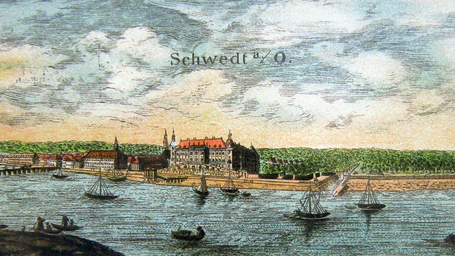
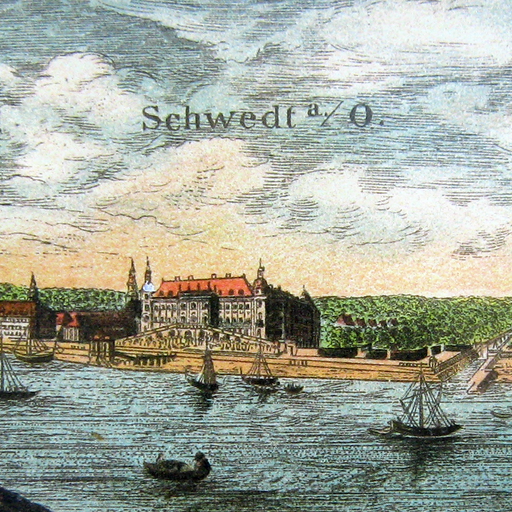
Schwedt Palace, located in Schwedt/Oder, Brandenburg, Germany, was a significant residence for the Hohenzollern family's Brandenburg-Schwedt branch. Originally built between 1553 and 1569, the palace was severely damaged during the Thirty Years' War. In 1670, Kurfürstin Dorothea purchased the estate to provide a residence for her son, Philipp Wilhelm. Dutch architect Cornelis Ryckwaert was commissioned to renovate and expand the Renaissance-style structure, incorporating surviving elements. The renovations were completed in 1685, and from 1701 to 1704, Martin Heinrich Böhme added a north wing, giving the palace its baroque character. The garden façade featured two towers and a central gable-decorated risalit, with a Baroque park in front. A 100-meter-wide chestnut alley led to the grand courtyard. The palace was inhabited from 1689 until the late 18th century but was largely unoccupied in the 19th and early 20th centuries. During World War II, it suffered severe damage from artillery fire and was demolished in 1962. The site now hosts a cultural center, the Uckermärkischen Bühnen Schwedt. The former palace garden has been transformed into the European Huguenot Park, featuring replicas of baroque sculptures and a historical sundial.