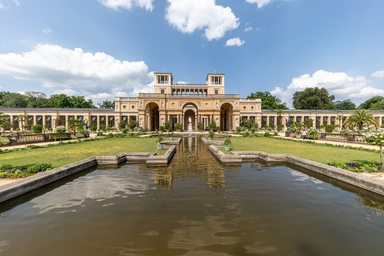
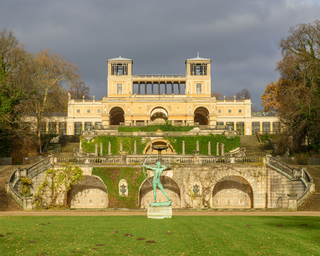
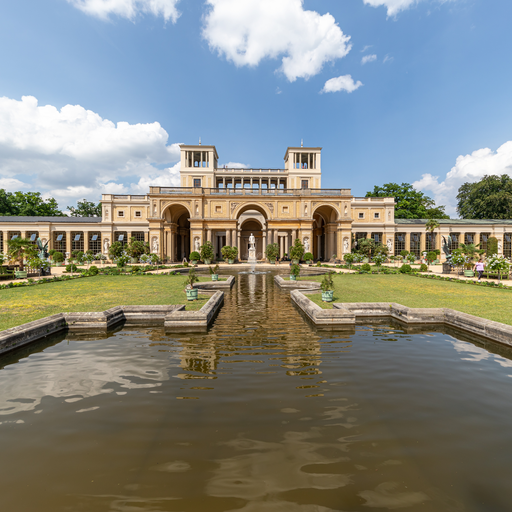
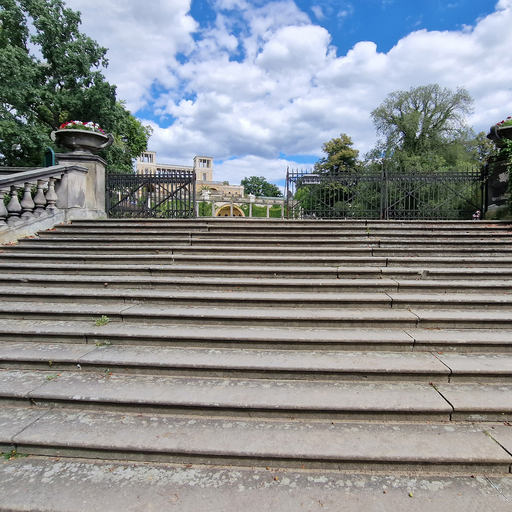
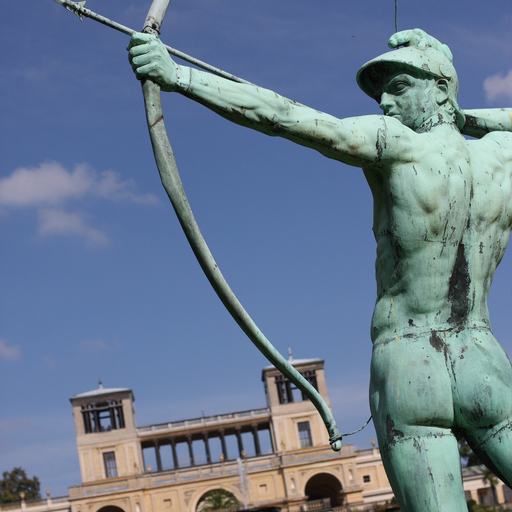
Renaissance Revival palace in Sanssouci Park, Potsdam, Germany.
The Orangery Palace, located in Sanssouci Park, Potsdam, Germany, was built between 1851 and 1864 for Frederick William IV. Designed in Italian Renaissance style by architects Friedrich August Stüler and Ludwig Ferdinand Hesse, it features a 300-meter facade and is part of the UNESCO World Heritage site.
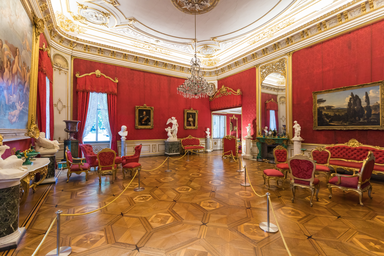
The Orangery Palace, also known as Orangerieschloss, is located in Sanssouci Park, Potsdam, Germany. Constructed between 1851 and 1864, it was commissioned by King Frederick William IV of Prussia. The palace is a striking example of Renaissance Revival architecture, inspired by the Villa Medici in Rome and the Uffizi in Florence. Designed by architects Friedrich August Stüler, Friedrich Ludwig Persius, and Ludwig Ferdinand Hesse, the building features a 300-meter-long facade and a central structure with twin towers. The palace includes the Raffael Hall, modeled after the Sala Regia in the Vatican, which houses over fifty copies of Renaissance paintings and frescoes. The royal apartments, decorated in the Rococo style, were intended for Tsar Nicholas I of Russia and his wife, Alexandra Feodorovna. The palace also served as a guest residence and an orangery. After World War II, it housed the Brandenburg State Archive until 2010. Since 1990, the Orangery Palace has been part of the UNESCO World Heritage site "Palaces and Parks of Potsdam and Berlin." Today, it functions as a greenhouse, exhibition, and concert venue, managed by the Prussian Palaces and Gardens Foundation Berlin-Brandenburg.