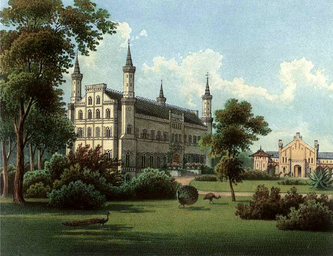
Heritage château in Kröchlendorff, Brandenburg, with an English Gothic mansion.
Schloss Kröchlendorff is a château and architectural heritage monument in Kröchlendorff, a settlement in Nordwestuckermark, Brandenburg, Germany. Built from 1846 in English Gothic Revival style for Oskar von Arnim, it stands in a park designed by Peter Joseph Lenné and now serves as an educational and seminar centre.
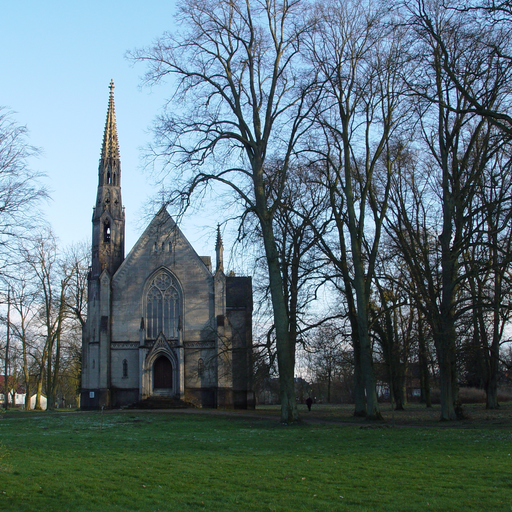
Schloss Kröchlendorff is a château in Kröchlendorff, a settlement in the municipality of Nordwestuckermark in Brandenburg, Germany, about 10 kilometres west of Prenzlau. It is listed as an architectural heritage monument in Brandenburg and forms part of a village notable for extensive monument protection. The estate belonged to the von Arnim family from 1429. The present manor house was commissioned by Oskar von Arnim, who laid its foundation stone in 1844 and had it built from 1846 by the Berlin architect Eduard Knoblauch in the style of English Neo-Gothic. The surrounding park landscape was designed on his behalf by Peter Joseph Lenné. In the southeastern part of the park, the neo-Gothic castle church was built between 1864 and 1868 to plans by Ferdinand von Arnim. During the final years of the Second World War, part of the Japanese embassy was evacuated from Berlin to Kröchlendorff. After the war, the Soviet Union expropriated owner Detlev von Arnim in 1945. Refugees and displaced people were housed in the château, and from 1962 until 1989 it served as a children's convalescent home. Since 1993, after restoration and the addition of accommodation completed in 1996, it has been used by Deutsche Gesellschaft für Europäische Erziehung, Outward Bound, as an education and seminar centre.