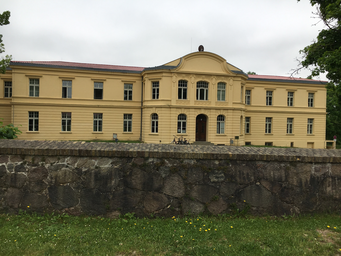
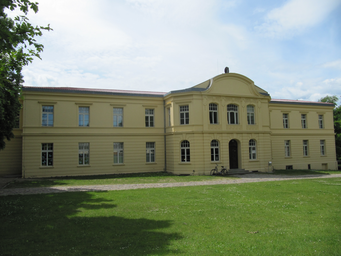
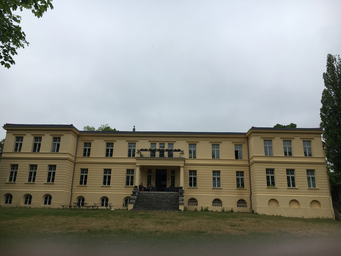
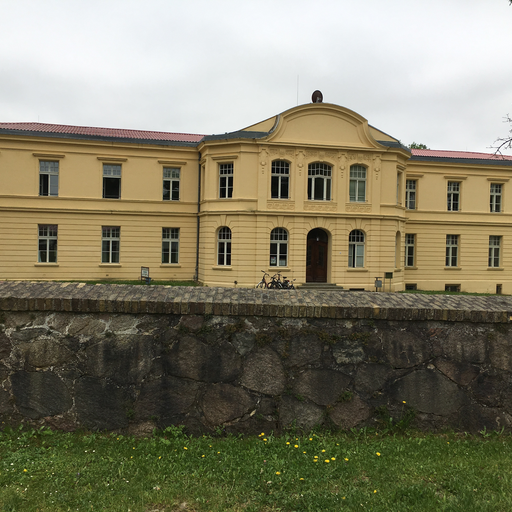
Two-story manor house in Gerswalde, Germany, with historical significance.
Schloss Gerswalde is a two-story manor house in Gerswalde, Germany, part of a larger estate with a park and garden. Originally linked to Burg Gerswalde, it was transformed into its current form around 1900 by Felix von Arnim. It is a designated cultural heritage monument.
Schloss Gerswalde is a two-story manor house located in the village of Gerswalde, Brandenburg, Germany. Situated southwest of the town center and east of the ruins of Burg Gerswalde, it is part of a larger estate that includes a park, garden, gardener's house, and greenhouses. Originally, the structure was part of the outer fortifications of Burg Gerswalde, owned by the von Arnim family since 1463. A manor house was constructed in 1724 and later converted into a castle around 1832. The building, known as the "Weiße Hof," reached its final form around 1900 under Felix von Arnim and his American wife Emily, who financed the renovation with US dollars. They added features such as a central staircase, large stone terraces, a stable, and a castle pond. The estate is recognized as a cultural heritage monument in Germany. Emily von Arnim introduced Californian table fruits to the garden, enhancing its reputation beyond the Uckermark region. After a fire in the mid-1960s, the mansard roof was not restored. Today, the estate is used as a children's and youth home, operated by a non-profit organization, and the park is open to the public.