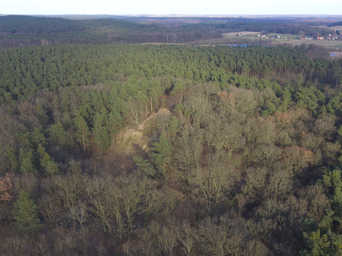
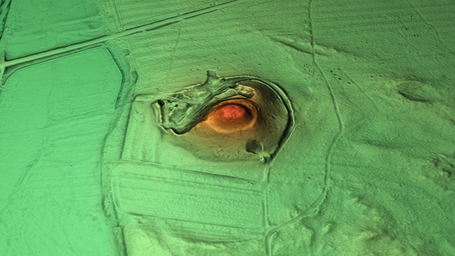
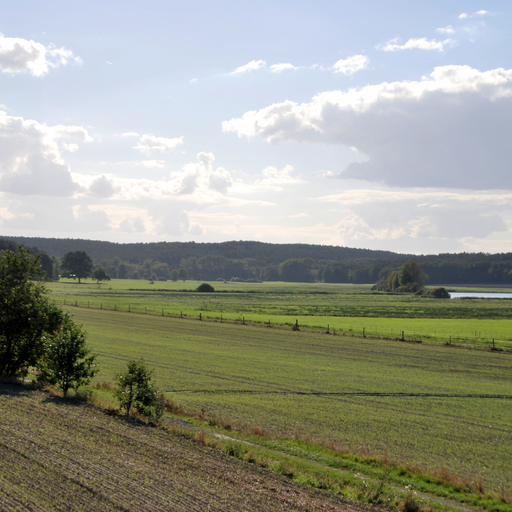
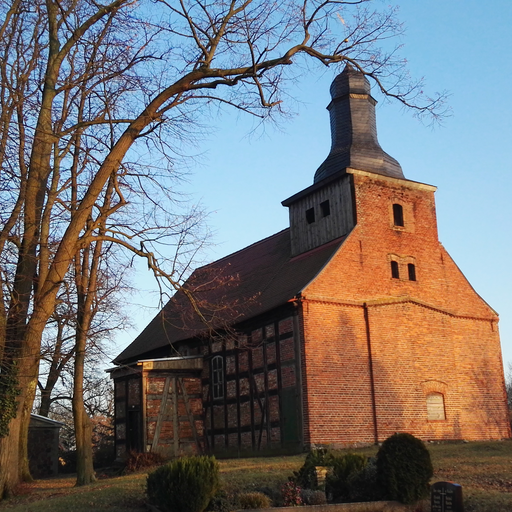
Landin Castle is a deserted medieval hill castle located near the village of Landin in the municipality of Kotzen, Brandenburg, Germany. Situated on the 55-meter-high Teufelsberg, also known as Rhinsberg, this site is a significant archaeological monument. The castle was the only known hill castle in the Havelland region during the Middle Ages, where lowland castles, such as swamp castles, were more typical. Archaeological investigations, including those by Alfred Götze in 1899 and later by Felix Biermann and Normen Posselt, revealed a rich cultural layer with early German pottery fragments, stones, animal bones, and evidence of Slavic graves and Neolithic settlements. The castle, constructed entirely of wood, featured a central keep and was heavily populated in the latter half of the 12th century. Its construction style resembled those in the Harz foreland under Ascanian rule, serving as a northern defense for the Ascanian-controlled Margraviate of Brandenburg. The site is registered as a protected archaeological monument, highlighting its historical significance as a German medieval castle, a Neolithic settlement, and a Slavic medieval burial ground. Today, the remnants of Landin Castle offer insights into the region's medieval history and cultural heritage.