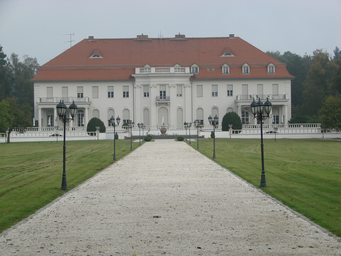
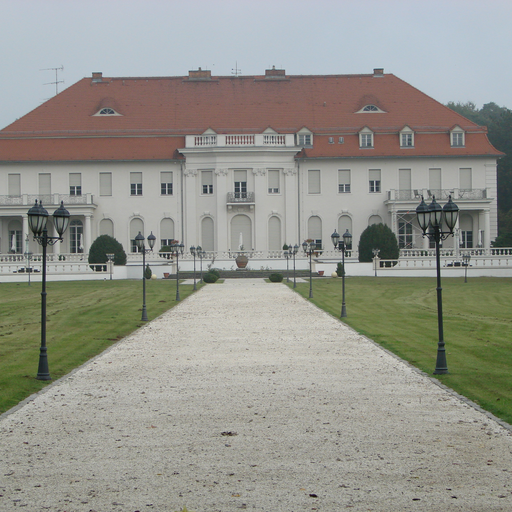
Neobaroque manor house in Bärenklau, Brandenburg, built 1928-1930.
Schloss Bärenklau is a Neobaroque manor house in Bärenklau, Schenkendöbern, Brandenburg, Germany. Built between 1928 and 1930 for textile factory owner Ernst C. Lehmann, it is a protected architectural heritage monument. Designed by Alfred Breslauer, it features a mansard roof and serves as a cultural heritage site.
Schloss Bärenklau is a manor house located in the village of Bärenklau, part of Schenkendöbern in the Landkreis Spree-Neiße region of Brandenburg, Germany. Constructed between 1928 and 1930, it was commissioned by Ernst C. Lehmann, a textile factory owner from Guben. The estate of Bärenklau has a long history, first documented in 1295, and experienced numerous ownership changes over the centuries. In the early 20th century, Hugo Hardy acquired the estate and later transferred it to his daughter, who sold it to Lehmann in 1926 for 45,000 Reichsmarks. The manor house, designed by architect Alfred Breslauer with assistance from Paul Salinger, is a Neobaroque-style structure featuring a two-story building with a mansard roof and a prominent portico on the north facade. The building is constructed from solid masonry with a stucco finish. Schloss Bärenklau is recognized as a protected architectural heritage monument in Brandenburg's Denkmalliste. After World War II, the property was used by the Free German Trade Union Federation and later served various educational purposes. Following German reunification, it was privatized and now houses the Living Bauhaus Kunststiftung, serving as an exhibition space and art collection, preserving its historical and cultural significance.