Renaissance castle built on former monastery site in Brandenburg, Germany.
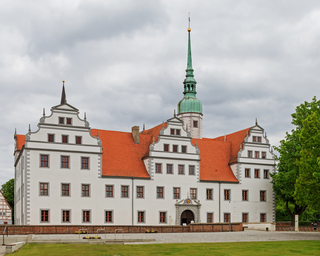
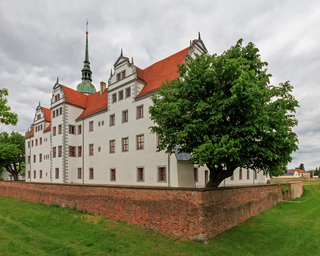
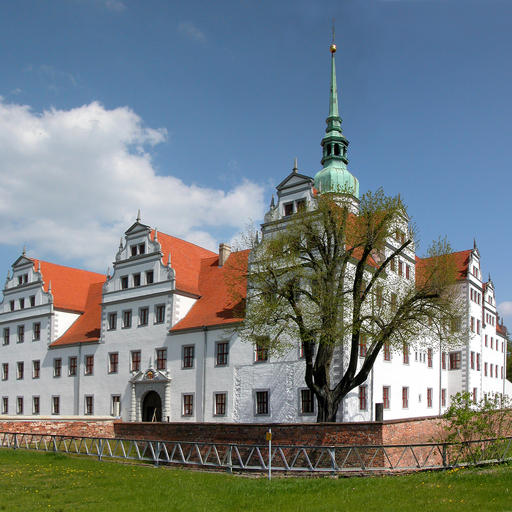
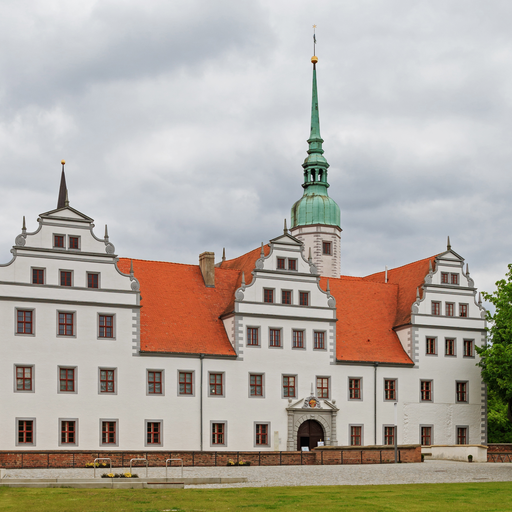
Schloss Doberlug is a Renaissance castle located in Doberlug-Kirchhain, Brandenburg, Germany. It was constructed on the site of a former Cistercian monastery, which was secularized in 1541. The castle's construction began in 1551 under Heinrich von Gersdorff, who transformed the abbot's house into a four-winged structure. Over the years, it served various purposes, including a hunting lodge and a noble residence. In 1623, Elector Johann Georg I of Saxony acquired the castle, and his son, Christian I, completed its construction in 1676. The castle features a slightly irregular rectangular layout, surrounded by a dry moat, with white facades and red tiled roofs. Notable architectural elements include spiral staircases, a round courtyard fountain, and decorative gables. After the Thirty Years' War, the castle became a widow's residence and later housed various administrative offices. In the 20th century, it served as a barracks for the National People's Army. Restoration efforts began in the late 20th century, and in 2014, it hosted the First Brandenburg State Exhibition. Today, Schloss Doberlug functions as a museum, offering guided tours and exhibitions that explore its rich history and the region's cultural heritage.