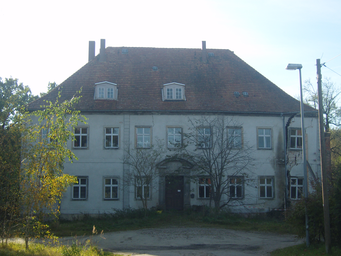
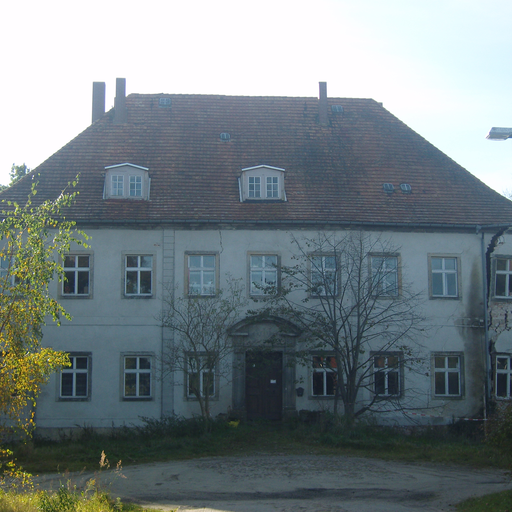
Historic manor house in decay in Luckaitztal, Brandenburg, Germany.
Schloss Neudöbern, also known as Herrenhaus Neudöbern, is a historical manor house in Neudöbern, Luckaitztal, Brandenburg, Germany. Built in 1703 by order of Saxon Elector August II, it is a protected architectural heritage monument but currently in a state of decay.
Schloss Neudöbern, also known as Herrenhaus Neudöbern, is a historical manor house located in the village of Neudöbern, within the municipality of Luckaitztal in the Oberspreewald-Lausitz district of Brandenburg, Germany. The manor house is recognized as an architectural heritage monument but is currently in a state of decay. Construction of the Herrenhaus began in the early 18th century under the orders of Saxon Elector August II, also known as Augustus the Strong, and was completed in 1703. Before this, a water castle existed on the site, first mentioned in 1440. Initially, the manor was used by the Thielau/Thilau noble family, who held feudal rights over Neudöbern. In 1890, the property came into the possession of the family of Count Wilhelm von Pourtalès. The building is a two-story Baroque structure with nine bays and a hipped roof, standing on a fieldstone pile foundation. It faces threats from subsidence due to groundwater lowering. Despite its protected status, no recent renovations have been reported. Schloss Neudöbern is located on Lindenallee and holds significant cultural and historical value, documented in the Dehio guidebook for Brandenburg. For more information, contact the Brandenburg State Office for Monument Preservation.