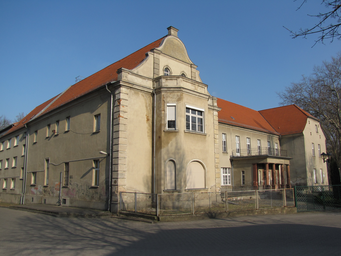
Historic castle complex in Zossen, Brandenburg, Germany, from 13th century.
Zossen Castle is a former castle complex and architectural monument in Zossen, Brandenburg, Germany. Built in the 13th century as a water castle, possibly on a former Slavic fortification, it was later remodeled several times. The ensemble stands in Zossen’s town park and is now used as office and commercial space.
Zossen Castle, officially known as "Schlossanlage mit Hauptgebäude, Torhaus, Rondell, Wallanlage, Gewölbegang, Pferdestall und Remise," is a historic castle complex located in Zossen, Brandenburg, Germany. It is recognized as an architectural heritage monument. The castle was originally constructed in the 13th century as a water castle on a small hill, possibly on a former Slavic fortification site. Initially part of the Markgrafschaft Meißen, it served as a border fortress. Ownership changed hands several times, notably to Johann Cicero, Margrave of Brandenburg, in 1490. Eustachius von Schlieben expanded it into a fortification in 1536. The castle complex includes several structures such as the Torhaus (gatehouse), Bastion, and Wallanlage (wall structure). The main building, known as the Herrenhaus, was constructed between 1580 and 1600 and has undergone multiple renovations. It features an H-shaped design with two stories, saddle roofs, and gable roofs. The Torhaus dates back to around 1500 and has a hipped roof. The castle is situated on Kirchstraße in Zossen, accessible via Bundesstraße 96 and 246. Today, it is managed by the Brandenburg State Office for Monument Conservation and Archaeological State Museum and serves as a historical monument.