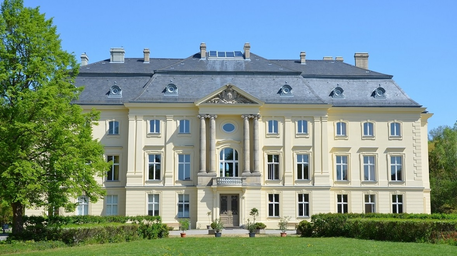
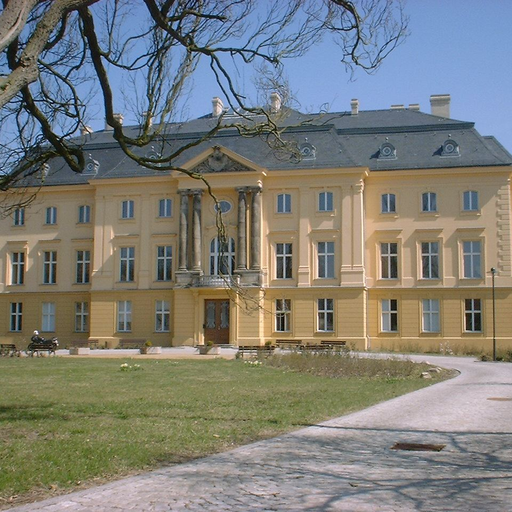
18th-century château and heritage site in Müncheberg, Brandenburg, Germany.
Schloss Trebnitz is an 18th-century château in Müncheberg, Brandenburg, Germany. The estate includes a main castle, honor court, park, and former residential buildings, all protected as architectural heritage monuments. It serves as a cultural and educational center, focusing on international exchange projects, particularly with Poland.
Schloss Trebnitz is a historic château located in the village of Trebnitz, part of Müncheberg in the Märkisch-Oderland district of Brandenburg, Germany. The estate, dating back to the 18th century, includes the main castle, an Ehrenhof (honor court), park, and various former residential and economic buildings. It is recognized as an architectural heritage monument due to its historical, urban planning, and cultural significance. The origins of Trebnitz trace back to 1124, founded by the Schlesische Kloster Trebnitz. The area was part of Lebus Land until the Askanier Markgrafen von Brandenburg took control in the 13th century. The village was destroyed by Hussites in 1432. The estate underwent significant renovations between 1904 and 1910 under the Brünneck family, transforming it into a neo-baroque-style château. Today, Schloss Trebnitz is managed by the Verein Schloss Trebnitz Bildungs- und Begegnungszentrum e.V., focusing on cultural and educational programs, particularly fostering German-Polish relations. The site hosts various events, workshops, and international exchange projects. The castle complex, with its extensive park designed by Johann Gottlieb Gleditsch and later redeveloped by Peter Joseph Lenné, remains a significant cultural and historical landmark in the region.