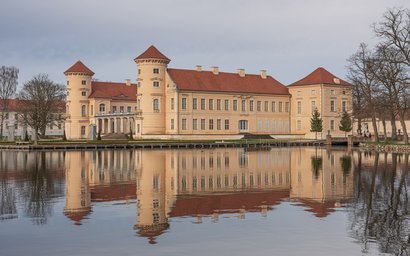
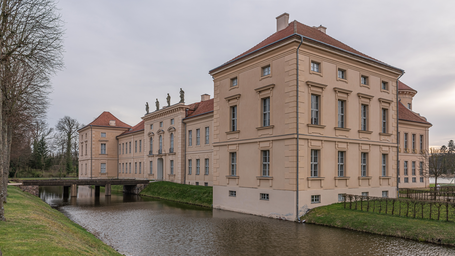
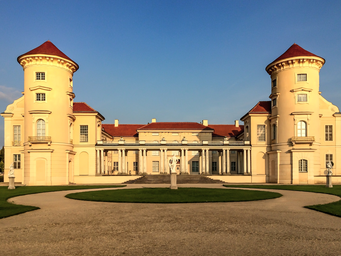
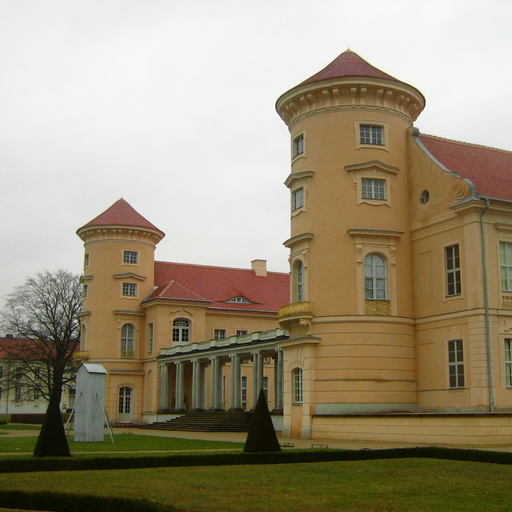
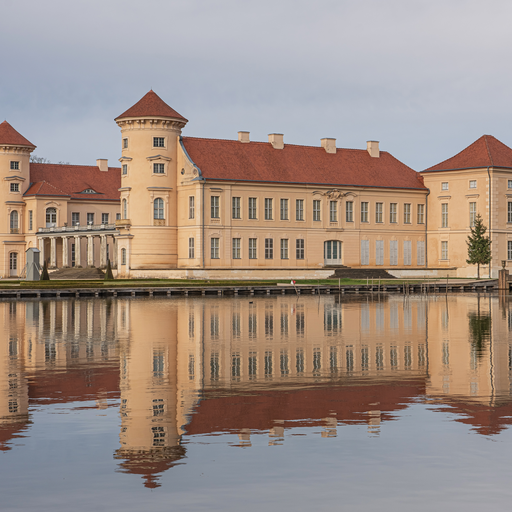
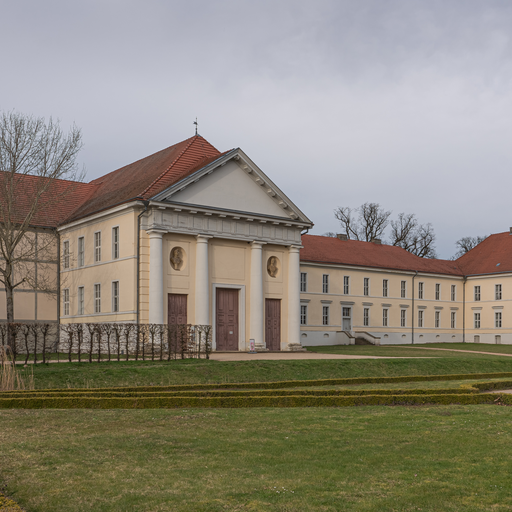
Baroque palace in Rheinsberg, Brandenburg, near Grienericksee lake.
Rheinsberg Palace, located in Rheinsberg, Brandenburg, Germany, is a notable example of Frederician Rococo architecture. Originally a Renaissance castle, it was transformed in the 18th century under architects Johann Gottfried Kemmeter and Georg Wenzeslaus von Knobelsdorff. The palace now hosts a literary museum and a chamber opera festival.
Rheinsberg Palace, located in Rheinsberg, Brandenburg, Germany, is a notable example of Frederician Rococo architecture. Situated on the eastern shore of Lake Grienericksee, the palace was originally a Renaissance moated castle built in 1566 by the von Bredow family. It suffered damage during the Thirty Years' War and changed hands several times before being purchased by Prussian King Frederick William I in 1734. He gifted it to his son, Crown Prince Frederick, who later became King Frederick II of Prussia. Frederick and his wife, Elisabeth Christine, moved into the palace in 1736, and it was expanded under the direction of architects Johann Gottfried Kemmeter and Georg Wenzeslaus von Knobelsdorff. Frederick described his years at Rheinsberg as the happiest of his life. In 1740, upon ascending the throne, he left the palace, later gifting it to his brother, Prince Henry of Prussia, in 1744. Prince Henry further developed the estate, adding pavilions and a pyramid-shaped crypt known as the Rheinsberg Obelisk. The palace gained literary fame through works by Theodor Fontane and Kurt Tucholsky. Today, it houses the Kurt Tucholsky Literature Museum and hosts an annual chamber opera festival, managed by the Prussian Palaces and Gardens Foundation Berlin-Brandenburg.