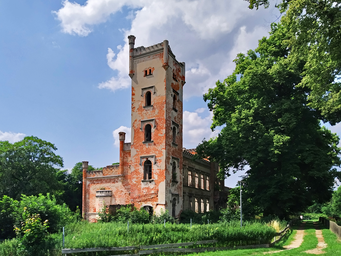
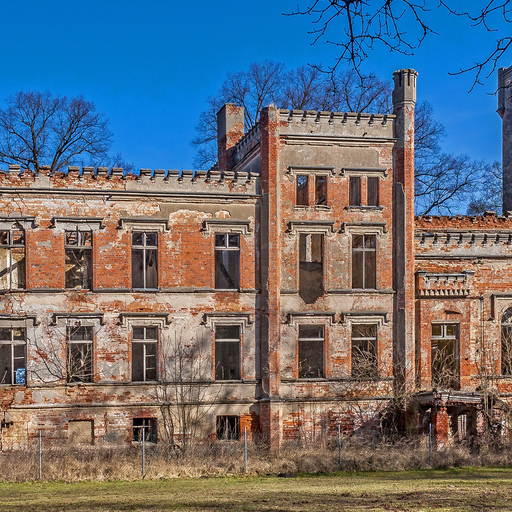
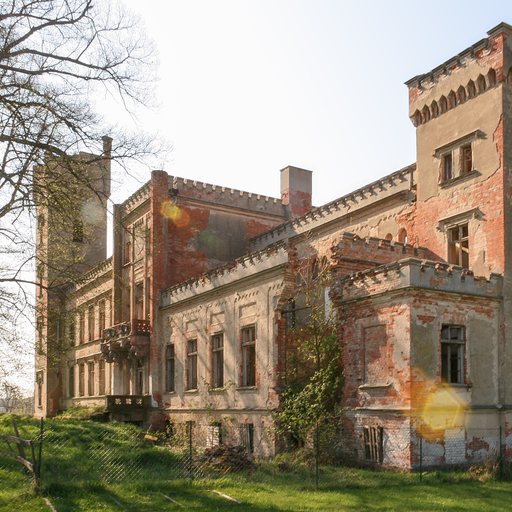
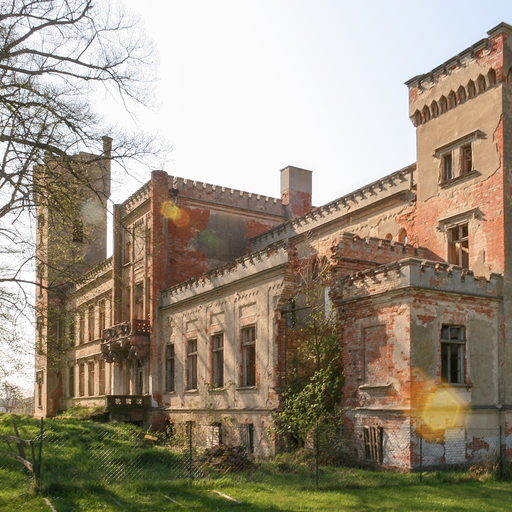
Castle ruin in Hohenlandin, former 1861 Tudor-style manor house.
Schlossruine Hohenlandin is the ruined manor house of the Hohenlandin estate in Brandenburg, Germany, within Schwedt/Oder. The former castle was built in 1861 in Tudor style, and a park designed by Lenné in 1822 lies to its west. It forms part of a listed estate complex.
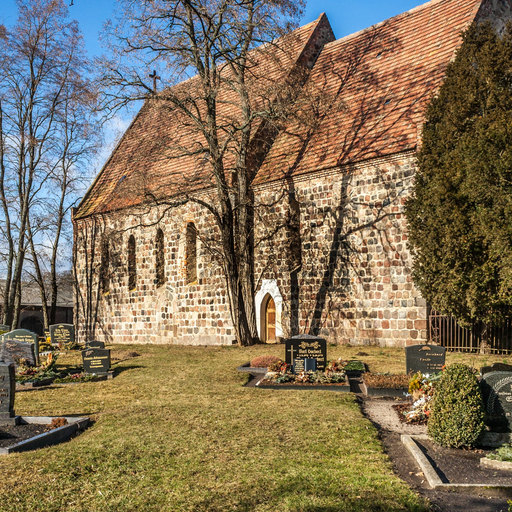
Schlossruine Hohenlandin is the ruined manor house of the former estate complex in Hohenlandin, a populated district of Landin in the city of Schwedt/Oder, Uckermark, Brandenburg, Germany. The former castle is listed as part of a heritage ensemble that includes the manor house ruin, estate park, and farmyard. According to the provided text, the building was erected in 1861 in Tudor style. It was commissioned after Wilhelm Georg von Warburg had a new residence built on the foundations of the old manor house in 1860/1861; Ferdinand Neubert-Wrietzen is named as architect. The Hohenlandin estate had passed through several noble and landed families over the centuries, including the von Biesenbrücher, von Wichmannsdorf, von Stephany, von Beer, von Zastrow, von Warburg, and later the Müller family. In the late 19th century the estate is recorded as having more than 1,000 hectares. West of the castle stands the park designed by Lenné in 1822, also included in the protected estate grounds. The ruin is mentioned in the local monument list together with other historic buildings in Hohenlandin, such as the village church and the former school. A 2013 photograph in the source identifies the site specifically as Schlossruine Hohenlandin.